Real-Time Hospital Operations Analytics: 40-Minute Batch to 8-Second Streaming Across 12 Data Sources
Unified HIS, LIS, ICU monitors, and PACS feeds into a real-time operations layer. Bed-turnaround time down 26%. Emergency triage decisions down from 14 minutes to 4.
data sources unified
end-to-end freshness (from 40-min batch)
faster bed turnaround
A multi-facility hospital network with 820 beds and roughly 3,200 admissions per month was operating on a Frankenstein reporting stack.
Twelve source systems (HIS, two LIS instances, PACS, ICU vitals, ED tracker, pharmacy, HR, finance, two facilities systems, and a home-grown occupancy spreadsheet) were being manually exported nightly and stitched together in Excel by a two-person MIS team. Reports arrived 24 to 72 hours late.
Executive decisions on ICU capacity, staff overtime, and OT-block reshuffling were made on stale data.
AUERON's data engineering team built a HIPAA-conscious streaming platform that ingests eleven of those twelve sources in real time. The twelfth was retired. End-to-end freshness landed at eight seconds.
The bed-management team measured a 26% reduction in average bed-turnaround time after go-live. The ED triage decision cycle dropped from a fourteen-minute human read to four minutes.
The Problem & Operational Risk
The client's twelve source systems spoke six different protocols. The HIS (a locally-customized vendor product) exposed only nightly SFTP dumps. The two LIS instances used HL7 v2.5 over MLLP. The ICU monitors emitted binary vendor-specific streams over an internal VLAN. PACS was DICOM-only. The ED tracker had a REST API but rate-limited to 60 requests per minute. The rest were older systems with only Oracle or SQL Server tables that could be queried directly.
The MIS team's process was to export CSVs each night, dedupe patient identifiers by hand, reconcile discrepancies against a printed ledger, and produce a morning "readiness pack" for the leadership team. There was no master patient index; the HIS ID, ED ID, and PACS ID were all different. On busy weekends, the pack was often skipped entirely.
The consequences were operational and financial. Bed turnaround averaged 3 hours 48 minutes against a target of under 2 hours. Housekeeping was frequently dispatched to already-cleaned rooms while newly-vacated rooms sat un-notified.
ICU capacity forecasts were wrong roughly 30% of the time, driving both cancelled elective admissions and last-minute overtime shifts. And no one could tell leadership, on any given afternoon, how many beds were actually available in the next twelve hours.
The bottleneck was never database speed. It was identifier reconciliation. A functioning master patient index unlocked more than any query engine choice.
Engineering Architecture & Solution
AUERON scoped the engagement in four phases.
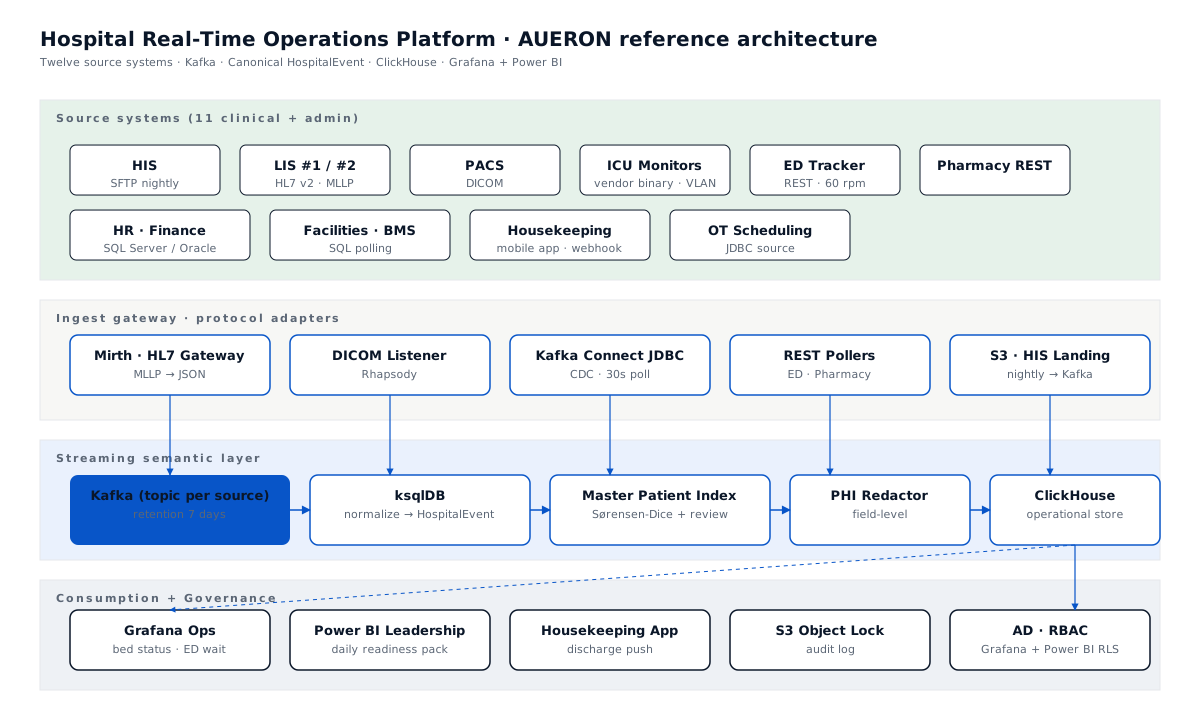
Phase one built the ingestion perimeter. An HL7 v2 gateway using Mirth Connect for the LIS feeds. A Rhapsody-based DICOM listener for PACS. A Kafka Connect JDBC source for the SQL-server-backed systems. An S3-listener for the HIS SFTP dumps (kept for historical continuity). Small collectors for the ED and pharmacy REST APIs. Every source landed on a Kafka topic within thirty seconds of the source event.
Phase two built the semantic layer. A stream-processing job in ksqlDB normalized every source event into a canonical HospitalEvent schema: patient, encounter, location, event type, timestamp. A master patient index built with Sørensen-Dice string matching plus manual review resolved the identifier fragmentation. Curated tables were materialized into ClickHouse, chosen for its column-store speed on time-window aggregations over hundreds of millions of rows.
Phase three delivered the operational dashboards on Grafana and Power BI. Bed status, ED wait time, ICU capacity trends, OT utilization, and staff overtime were the initial five.
Phase four introduced governance. PHI redaction at the ingest layer for any field flagged as identifying. Immutable audit log via S3 Object Lock. Role-based access via Grafana + Power BI RLS tied to Active Directory. A signed data-processing agreement with every downstream consumer.
Key Architectural Takeaways
- The bottleneck was never database speed. It was identifier reconciliation. A functioning master patient index unlocked more than any query engine choice.
- HL7 v2 over MLLP is boring, ubiquitous, and still the fastest way to get real-time clinical data out of most hospital systems in India.
- PHI redaction at the ingest layer, not at query time, is the only strategy that survives audit. Query-time redaction is easy to bypass and hard to prove complete.
- ClickHouse handled 480M-row rolling-window aggregations at sub-second latency on a three-node cluster. A comparable Snowflake configuration was estimated at 4× the monthly cost.
- The 26% bed-turnaround improvement came before any ML model was deployed. It was purely from housekeeping getting real-time discharge notifications, replacing a phone-tree escalation that had one hour of built-in delay.
Explore More Case Studies
Fixing a Silent Fraud Model: MLOps Rescue for a Mid-Market Payments Platform
ECS to EKS Migration and 38% Cloud Cost Cut for a High-Traffic Indian E-Commerce Brand
Strangling a 380k-Line Django Monolith: Eight Services, 45-Minute Deploys to 6-Minute Deploys
Let's talk
Book your free consultation with an AUERON engineer
One senior engineer will respond within one business day.
Prefer email? hello@aueron.in