Strangling a 380k-Line Django Monolith: Eight Services, 45-Minute Deploys to 6-Minute Deploys
A measured, non-freezing decomposition for a growing B2B SaaS. Eight services. Monthly incidents from 9 to 1. Deploy time 87% lower.
services extracted from monolith
deploy lead time (from 45 min)
monthly Sev-1 incidents
A B2B SaaS platform serving roughly 24,000 professional users on a 380,000-line Django monolith had hit a growth ceiling that wasn't about customers. It was about engineering throughput.
Deploys took 45 minutes and were bundled once a week. Sev-1 incidents were averaging nine per month, most traced to a single team's release colliding with another's. The engineering team was seven strong and could not hire faster than they could onboard. Onboarding itself averaged eleven weeks.
AUERON's software engineering team ran a measured strangler-pattern decomposition. Identify the two hottest boundaries first. Extract them. Iterate.
Eight services later, each with an ADR-documented boundary rationale, the platform now deploys per-service in six minutes on independent CI pipelines. Sev-1 incidents dropped to one per month. Time to onboard a new hire fell from eleven weeks to four.
The Problem & Operational Risk
The monolith itself wasn't badly written. It was a competently-built Django 3 application that had grown organically as the product added features.
Payments, invoicing, contact management, workflow automation, reporting, and the customer-facing embedded editor all lived in one repo behind one deploy artifact. Django migrations blocked all deploys. Any schema change required a coordinated review across the entire seven-person engineering team. Test suites had grown to 6,400 tests and took 22 minutes to run in CI, before the 23-minute Docker build and the eight-minute rollout.
The culture consequence was more expensive than the compute cost. Engineers batched changes into a single Friday release train because that's what the deploy cost incentivized. The train was long and heavy. Any bug in it caused a rollback of every other engineer's week of work. The team had developed elaborate feature-flag scaffolding to work around this, but the flags themselves had become a second, undocumented dependency graph.
The client had considered a rewrite. AUERON recommended against it. A full rewrite of a 380k-line profitable SaaS would have been a two-year risk. Instead AUERON proposed strangler-pattern decomposition targeting the specific boundaries where team autonomy was blocking throughput.
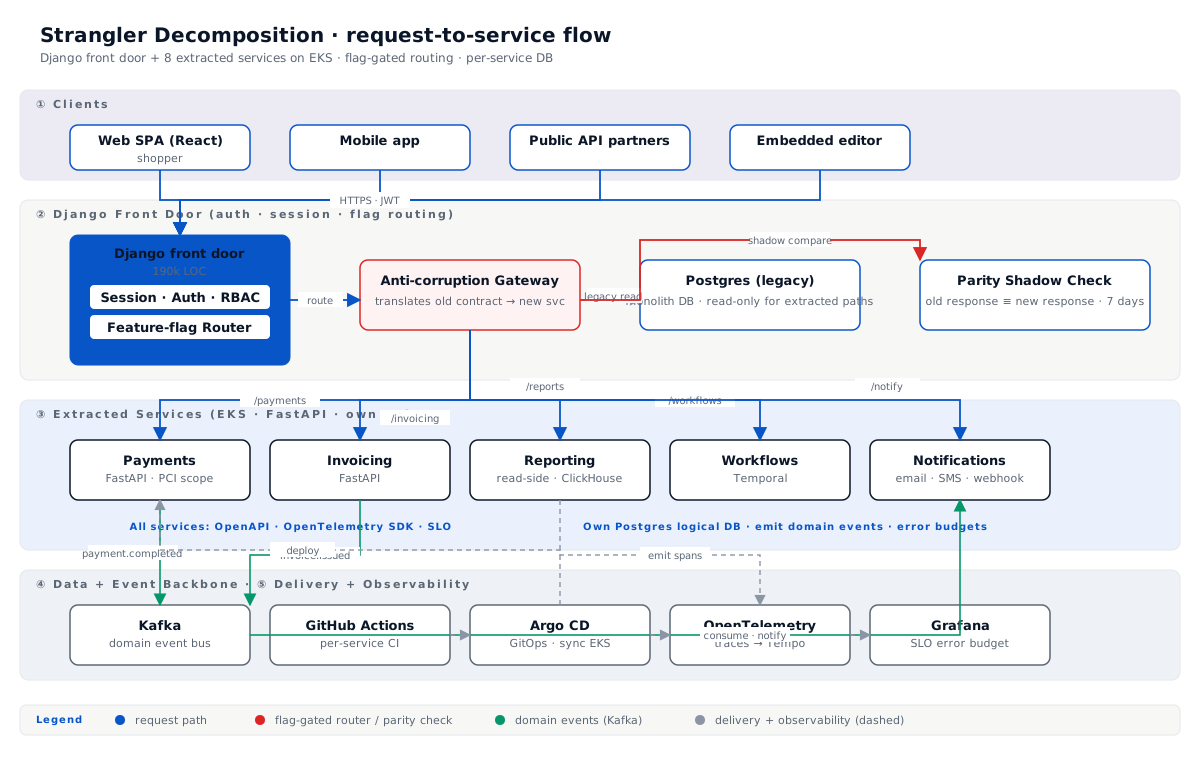
The strangler pattern only works when you have parity checks. Every extraction shipped behind a shadow-comparison of old vs new responses for a full week before the flag flipped.
Engineering Architecture & Solution
The first phase was purely inventory. AUERON's engineers pair-worked with the client team to map every module by three axes: release frequency (how often does this change), on-call touch (how often does this page someone), and cross-team edit rate (how many teams edit this in a typical month).
The heat map made the first two extraction candidates unarguable. The payments module was releasing four times a week but was blocking every unrelated deploy. The reporting module was consuming 40% of the monolith's database connection pool during business hours.
The next phase extracted the payments service. AUERON introduced a service-boundary contract (OpenAPI + shared types), a database seam (payments got its own Postgres logical database with dual-writes and eventual read-cutover), and an anti-corruption gateway inside the monolith to intercept calls. The extraction was gated behind a feature flag at 5%, then 25%, then 100% traffic, with parity checks between the old code path and the new service.
Subsequent phases followed the same pattern for reporting, invoicing, workflow automation, contact ingest, notifications, and the embedded editor's rendering worker.
The final phase delivered the platform tier. Shared Kubernetes cluster on EKS. Per-service CI pipelines on GitHub Actions. A lightweight service registry. Distributed tracing via OpenTelemetry. An SLO framework with error budgets per service.
The Django monolith itself was preserved as "the front door." It handles auth, session, and routing to the new services, and now weighs 190k lines instead of 380k.
Key Architectural Takeaways
- The strangler pattern only works when you have parity checks. Every extraction shipped behind a shadow-comparison of old vs new responses for a full week before the flag flipped.
- The right first service to extract is the one that's currently BLOCKING other teams, not the one with the cleanest boundary. Boundary quality was a distant second criterion.
- Feature flags built for the extraction can be reused for the extraction after that. AUERON's team built one flag framework and used it six times.
- Database logical separation is 80% of the value with 20% of the risk. Full physical separation (different clusters) was only pursued for payments where regulatory audit demanded it.
- OpenTelemetry from day one saved the team roughly two full sprint-cycles of ad-hoc debugging. When the reporting extraction produced 3% mismatched output, traces isolated the cause to a UTC/IST timezone confusion inside two hours.
Explore More Case Studies
Fixing a Silent Fraud Model: MLOps Rescue for a Mid-Market Payments Platform
ECS to EKS Migration and 38% Cloud Cost Cut for a High-Traffic Indian E-Commerce Brand
Real-Time Hospital Operations Analytics: 40-Minute Batch to 8-Second Streaming Across 12 Data Sources
Let's talk
Book your free consultation with an AUERON engineer
One senior engineer will respond within one business day.
Prefer email? hello@aueron.in